The Spinning Solution for Small Spaces
Do you dream of stepping just a few feet to snip fresh basil for your pasta or pluck fragrant rosemary for roasted vegetables? For those of us living in apartments, condos, or simply dealing with limited square footage, that dream often wilts under the reality of cramped kitchens and nonexistent garden plots. Even a sunny windowsill can be a precious commodity. The result? You’re left with overpriced plastic clamshells of herbs that spoil before you can use them, feeling like both a waste of money and a culinary compromise.
But what if your fresh herb garden wasn’t out there or down there, but right here—spinning gracefully to greet you? Enter the brilliantly space-efficient solution: the vertical, rotating herb garden. This clever concept takes your planting space up, not out, making the most of every inch and every ray of sunshine.
The perfect foundation for this project isn’t a fancy planter from a boutique, but a humble, often-overlooked hero of thrift stores and basements everywhere: the swivel barstool. With its sturdy base and rotating seat, it’s a found object waiting to be transformed. In this guide, we’ll upcycle this everyday item into a functional and stylish planter that’s as much a conversation piece as it is a practical kitchen helper.
Get ready to create a garden that not only maximizes light exposure by giving every plant its turn in the sun, but also saves valuable floor space, reduces waste through creative reuse, and injects a dose of unique, spinning charm into your home. Let’s turn that stale seat into a vibrant, revolving feast for the senses.
Why This Project Works: The Magic of the Swivel Stool
This isn’t just another DIY planter idea. There’s a specific, clever magic at work here that makes the humble barstool the ideal candidate for a compact herb haven. Let’s break down exactly why this project is such a winner.
The Swivel Advantage: Your Personal Solar Panel Think of the most coveted spot in any garden: the one that gets full, all-day sun. In a stationary planter, the plants on the sunny side thrive, while those in the shade struggle. A swivel stool solves this with elegant simplicity. With just a gentle nudge, you can rotate your entire garden, ensuring every basil leaf and sprig of thyme gets its fair share of sunlight throughout the day. It’s like giving each plant a daily sunbathing schedule, promoting even, lush growth without you having to constantly rearrange heavy pots. This built-in rotation feature is the secret sauce that turns a simple container into an intelligent gardening system.
The Upcycle Win: Sustainability with Soul In a world of mass-produced goods, there’s a profound satisfaction in rescuing an item from obscurity. That wobbly, dated stool headed for the landfill gets a second chance, carrying a story and character that a brand-new pot never could. Upcycling isn’t just about being eco-friendly (though diverting furniture waste is a major win); it’s about injecting creativity and personal history into your home. You’re not just making a garden; you’re preserving resources, saving money, and creating a piece with unique charm that no store can replicate.
The Vertical Vision: Look Up, Not Out Small-space living requires a shift in perspective—literally. Floor space is prime real estate, but vertical space is often underutilized. By elevating your garden onto a stool, you claim a patch of air instead of a patch of floor. This makes it perfect for tucking into a sunny kitchen corner, on a narrow balcony, or beside a patio door. It lifts your greenery to a visible, accessible height where it’s easy to care for and harvest, transforming dead space into a vibrant, living focal point.
Skill Level & Time: A Perfect Weekend Project Worried this is too ambitious? Fear not. This project is firmly in the beginner-friendly category. If you can handle a screwdriver, a drill for drainage holes, and a paintbrush, you have all the skills you need. The process is straightforward: prep, paint, plant. From start to finish, you can easily complete your rotating herb garden in a single weekend afternoon, with most of that time dedicated to letting paint dry. It’s the ideal blend of quick gratification and lasting reward.
Hunting & Gathering: What You’ll Need
Before we get our hands dirty, let’s gather our supplies. Half the fun of an upcycle project is the treasure hunt! Here’s your checklist for transforming a forgotten stool into a flourishing garden.
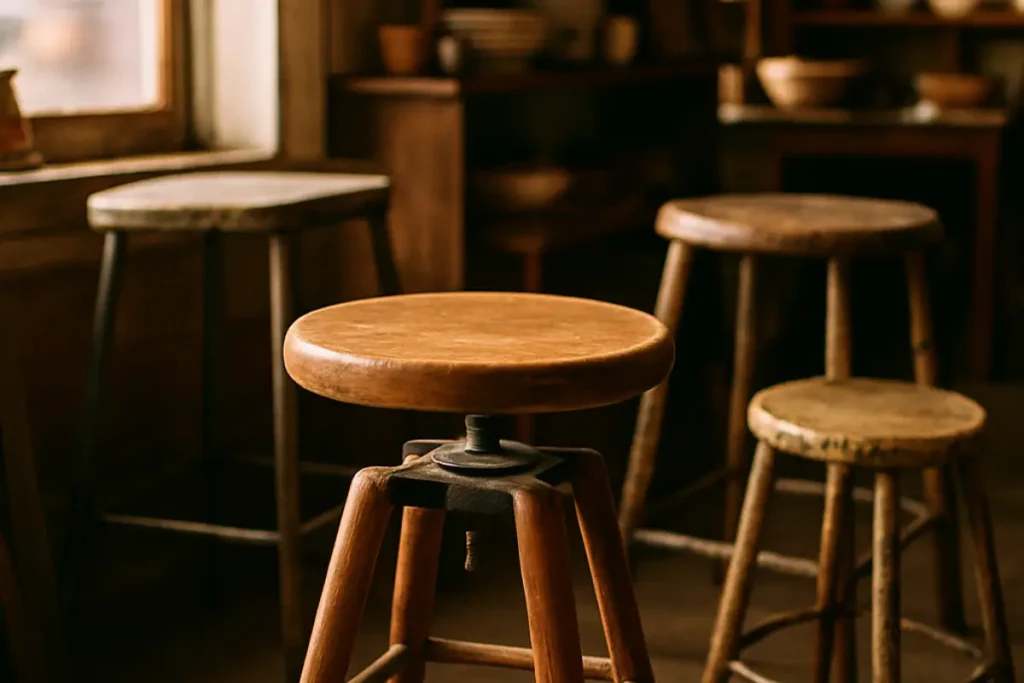
The Star: Finding the Perfect Barstool Your quest begins at thrift stores, flea markets, garage sales, or even the depths of your own basement. You’re looking for one key feature: a stable base and a functional swivel seat. The swivel is non-negotiable—it’s the heart of the project. Avoid stools with seats that don’t turn or are completely fixed.
- Ideal Candidates: A classic wooden barstool with a circular seat is perfect. Metal stools with a swivel top also work wonderfully.
- Look Past the Surface: Don’t be deterred by an ugly finish, a wobbly leg (this can usually be tightened), or a dated vinyl seat cover. We’re going to transform it. As long as the structure is solid and the swivel mechanism works, it’s a winner.
- Seat Size Matters: A seat between 12-16 inches in diameter is the sweet spot, offering ample planting space while remaining manageable.
Materials & Tools List:
Prep & Build Tools:
- Sandpaper (medium grit, ~120-grit): For scuffing up the surface so paint adheres properly.
- Drill with assorted bits: Essential for creating drainage.
- A large spade bit (½” to 1”): This is for drilling the crucial drainage holes in the seat. Multiple holes are key to preventing root rot.
- A standard drill bit for pilot holes if you need to secure a tray.
- Paintbrush or small foam roller: For a smooth finish.
Finishing Supplies:
- Exterior/Interior Paint or Stain & Brush: Your choice!
- Exterior-grade paint is more durable, especially if the garden will live on a patio.
- A fun, bright color adds pop; a stain highlights natural wood grain; white or black creates a modern look.
- Optional – Clear water-resistant sealant: A topcoat (like a polyurethane) adds an extra layer of protection against moisture and sun, extending the life of your paint job.
- Optional – Stencils, painter’s tape, or decorative knobs: For adding personalized flair to the seat or base.
The Gardening Kit:
- Plastic saucers or drip trays: This is our clever liner. Find one or two shallow trays that fit snugly within the rim of your stool seat. They will hold the soil and contain water, protecting the painted wood. Terra cotta saucers can be used but are heavier and may require more sealing.
- High-quality potting mix: Use a mix formulated for containers or herbs. It drains well and is lighter than garden soil, which is crucial for success.
- Small herb plants or seeds:
- Starter plants from a garden center give you instant gratification.
- Seeds are more economical but require patience. Look for compact or “patio” varieties.
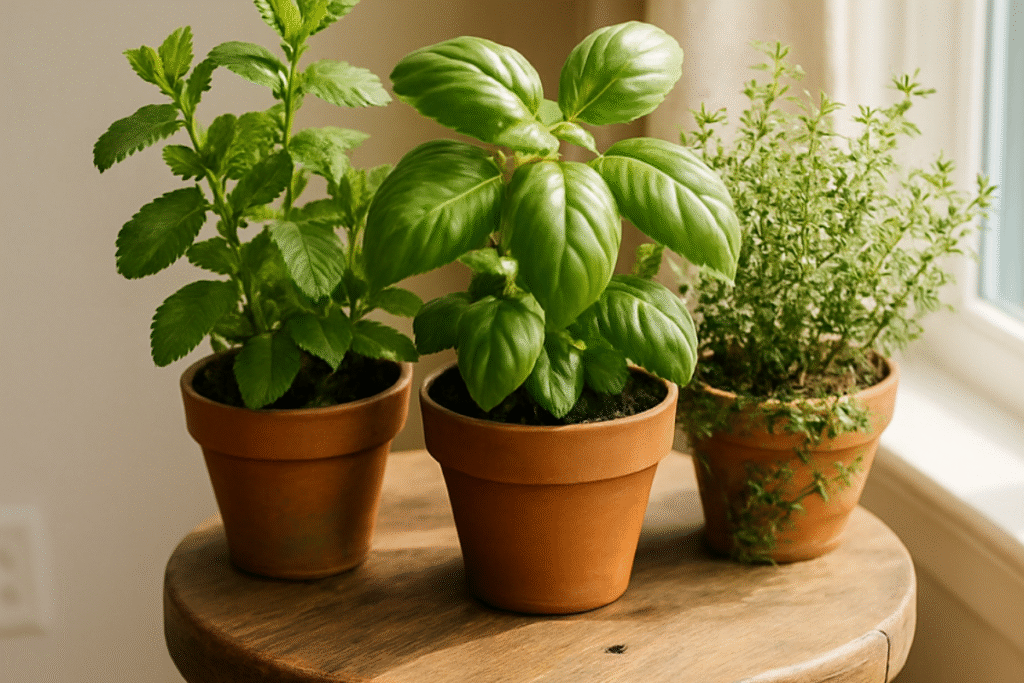
- Pro Tip: Choose herbs with similar light and water needs. A Mediterranean trio of rosemary, thyme, and oregano is drought-tolerant, while a culinary mix of basil, parsley, and chives likes more consistent moisture.
With your stool rescued and your supplies ready, you’re all set to begin the transformation. Let’s move on to the fun part!
The DIY Transformation: Step-by-Step Guide
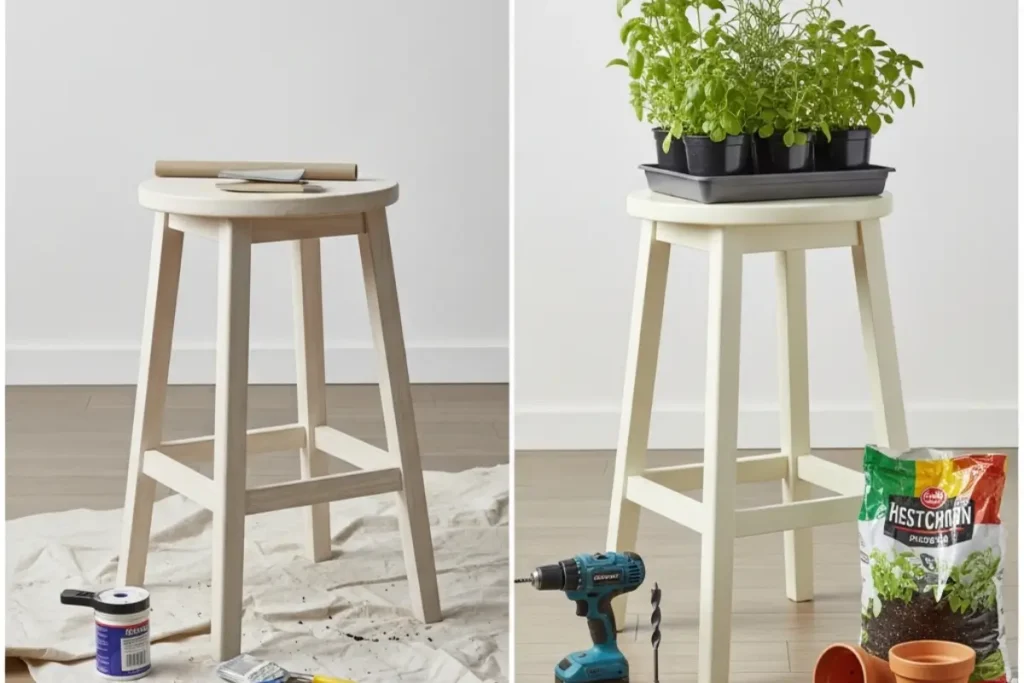
Now for the main event—transforming your found object into a functional garden. This process is satisfying, simple, and where your vision comes to life.
Step 1: Prep & Prime (The Clean Slate)
A successful upcycle starts with proper prep. This ensures your beautiful finish lasts.
- The Deep Clean: Wipe down the entire stool with a damp cloth to remove dust and grime. For sticky residues or old finish, use a mild degreaser or soapy water. Let it dry completely.
- Sand for Success: Lightly sand all surfaces you plan to paint with medium-grit sandpaper. You don’t need to strip it bare—just scuff up the surface to create “tooth” for the new paint to grip. Wipe away all sanding dust with a tack cloth.
- Drill for Drainage: This is the most critical functional step. Flip the stool over. Using your large spade bit, drill 3-5 large drainage holes (about ½-inch wide) evenly across the seat area. Good drainage is non-negotiable for healthy herbs; it prevents waterlogged soil and root rot.
Step 2: Paint & Personalize (The Creative Burst)
This is where you make it yours. Let your personality shine!
- Color Choices: Go bright and cheerful (sunny yellow, herb green) for a pop of kitchen joy, or choose rustic natural (a simple stain, sage gray, or weathered white) for a more subtle, farmhouse feel.
- Painting Techniques: Apply a thin, even first coat of paint or stain. Let it dry completely as per the can’s instructions, then apply a second coat for solid coverage. For extra flair:
- Color Blocking: Paint the base one color and the seat another.
- Ombre: Blend two shades of the same color from the center outward.
- Stenciling: Add a simple pattern or word (“HERBS,” “GROW”) to the seat after the base coat dries.
- Seal the Deal (Optional but Recommended): Once the paint is 100% dry, apply 1-2 coats of a clear, water-resistant sealant, especially if your garden will live outdoors. This protects your hard work from sun and water splashes.
Step 3: The Planting Platform (Functional Assembly)
Now, we make it ready for soil without damaging our fresh paint job.
- The Tray Method (Simplest): Place your plastic saucer or drip tray directly onto the seat. For a secure fit, you can apply a bead of strong, waterproof adhesive (like silicone caulk or E6000) around the rim of the tray before setting it in place. Let the adhesive cure fully.
- Creative Alternatives:
- Terracotta Pot: Find a shallow, wide terracotta pot that fits the seat. Secure it with adhesive designed for pottery/wood.
- Built-Up Border: Glue a circle of flexible plastic edging, a coiled rope, or even short sections of cedar fencing around the seat’s perimeter to create a raised lip that contains the soil.
Step 4: Green Thumb Time (Planting Your Garden)
The moment you’ve been waiting for—bringing it to life!
- Fill ‘Er Up: Pour your quality potting mix into the prepared platform, filling it to about 1 inch below the rim. Do not pack it down tightly; herbs prefer loose, aerated soil.
- Plan Your Layout: Gently arrange your herb pots on the soil surface before planting. Follow the “Thriller, Filler, Spiller” principle: place taller herbs (like rosemary or dill) in the center, bushy herbs (like parsley or basil) around them, and any trailing herbs (like creeping thyme or oregano) near the edges to cascade over.
- Plant Gently: Remove herbs from their nursery pots, gently loosen the roots if they’re tightly bound, and plant them in the soil. Firm the soil gently around each plant.
- The Final Touch: Water your newly planted garden thoroughly until water runs out of the drainage holes. Place it in its new sunny home and give it its inaugural, celebratory spin!
Pro-Tip: For an even smoother spin on a patio, place the entire stool on a large, heavy-duty lazy Susan. This creates a “turntable on a turntable” for effortless rotation.
Stand back and admire your work. You’ve just created a living, rotating centerpiece. Next, we’ll cover how to keep it thriving.
Style & Care: Making It Thrive
You’ve built a beautiful, functional piece—now let’s ensure it stays lush and becomes a seamless part of your home. A little know-how goes a long way in keeping your rotating garden happy.
Location, Location, Rotation Herbs are sun-worshippers. Place your garden where it will receive at least 4-6 hours of direct sunlight daily. A bright kitchen corner near a window, a sunny balcony spot, or a sheltered patio area are all perfect.
This is where the “swivel” earns its keep. Make a habit of giving the stool a quarter or half turn every morning when you check on it. This simple, consistent rotation prevents plants from leaning awkwardly toward the light and ensures every part of the canopy receives equal energy, resulting in symmetrical, full growth. Think of it as your daily mini-ritual with your garden.
Care Instructions: Simple Steps for a Bounty
- Watering Wisdom: The golden rule is to water deeply but infrequently. Check the soil by sticking your finger about an inch down. If it feels dry, it’s time to water. Pour water slowly at the base of the plants until you see a little moisture escape the drainage holes. Avoid frequent light sprinklings, which encourage shallow roots. In hot weather, you may need to water every other day; in cooler, cloudy weather, once a week might suffice.
- Light Feeding: Herbs aren’t heavy feeders. A light dose of a balanced, water-soluble organic fertilizer (like fish emulsion or a general-purpose plant food) every 3-4 weeks during the growing season (spring to early fall) is plenty. Over-fertilizing leads to lots of leaves with less flavor.
- Harvest to Encourage: Your most important gardening tool is your kitchen scissors! Harvest regularly by snipping leaves and stems. This actually promotes new, bushier growth. Never remove more than one-third of the plant at once. The more you use your herbs, the more they will produce.
Styling Your New Garden This piece is as much decor as it is function. Here’s how to style it:
- In the Kitchen: Tuck it beside the refrigerator, at the end of a counter, or in a sunny nook. Its vertical form takes up minimal counter space while keeping herbs within arm’s reach of your cutting board.
- On a Balcony or Patio: Use it as a living side table next to a chair, or as a centerpiece on a small bistro set. Pair it with other upcycled planters (like tin cans or wooden crates) for a cohesive, eclectic look.
- In a Sunny Entryway: Create a welcoming, fragrant greeting for guests. The compact footprint makes it ideal for brightening up an apartment entry or mudroom.
- The Mobility Advantage: One of its best features is the ability to move it easily. Roll it into a sunnier spot for the day, or spin it to showcase different plants when you have company. It’s a dynamic, living sculpture.
With the right spot, a simple care routine, and a little styling, your upcycled herb garden will be a thriving, beautiful part of your daily life for seasons to come.
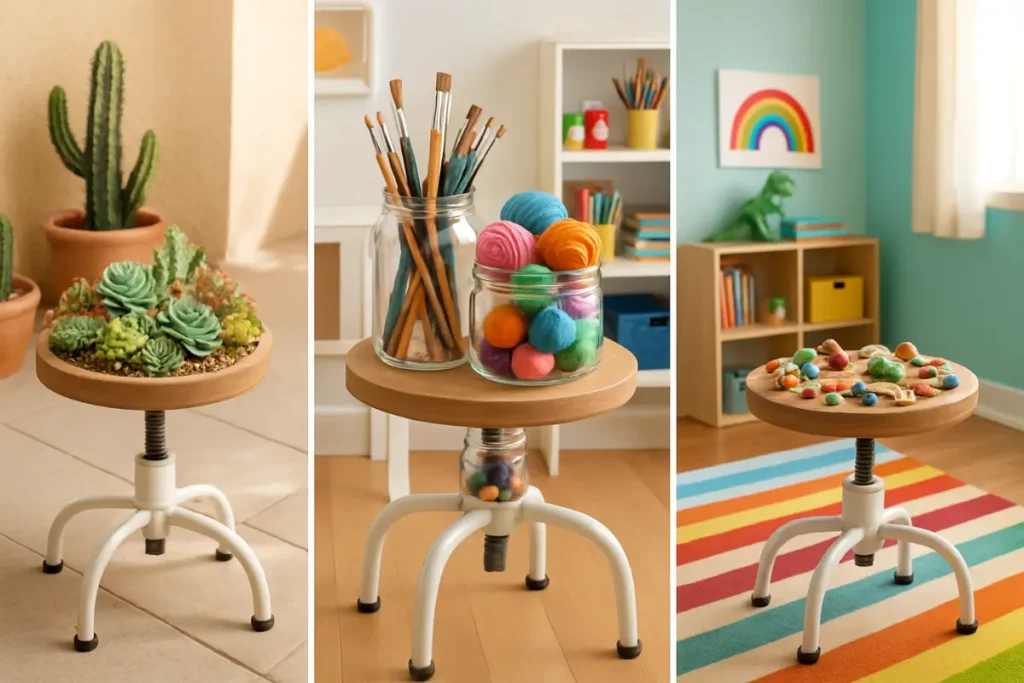
Spin-Off Ideas: Customize Your Creation
The beauty of this upcycle project is its incredible versatility. Once you’ve mastered the herb garden, you’ll start seeing potential everywhere. Here are some inspired spin-offs to customize your swivel stool for any room or hobby.
For a Sunny Patio: A Drought-Tolerant Display If your balcony gets blazing sun, swap the herbs for a stunning arrangement of succulents, sedums, or hardy hen-and-chicks. These plants thrive in bright light and require minimal water, making them perfect for low-maintenance outdoor living. Use a gritty, cactus-specific potting mix for excellent drainage. The rotating feature lets you showcase their geometric shapes from every angle and ensures even sun exposure to prevent stretching. It becomes a living sculpture for your patio table or deck corner.
For a Craft Room: The Ultimate Organizer Transform your stool into a functional, rotating command center for your creative space. Skip the soil and use the seat to hold small potted flowers for inspiration, mason jars full of paintbrushes and markers, or even neat balls of yarn. You can attach small wooden dowels to the seat to create a yarn bowl effect, or simply use the flat surface for a rotating tray of frequently-used tools. Every project supply is just a spin away, saving valuable desk space and adding a playful, productive touch to your room.
For a Kid’s Room: A Rotating Treasure Display Create a magical, interactive display for a child’s room. Paint it in their favorite vibrant colors. The seat can become a stage for a rotating collection of toy figures, dinosaur habitats, a fairy garden, or a display of special rocks and shells. It’s a brilliant way to contain and showcase small treasures that might otherwise clutter the floor, while encouraging imaginative play. The swivel action makes it easy for little hands to access everything and creates a dynamic focal point.
Bonus Utility: Add Hooks for Extra Function Maximize your creation’s utility by adding S-hooks or small cup hooks to the base or central column. Suddenly, your garden stool can also hold:
- Gardening tools: Trowels, pruners, and gloves hang neatly below the herbs.
- Kitchen linens: Hang tea towels or oven mitts from your kitchen herb garden.
- Craft supplies: Dangle scissors, measuring tapes, or ribbon spools in your craft room version. This simple addition marries form and function, creating a truly comprehensive organizational piece.
Let your needs and imagination guide you. This simple swivel stool framework is a canvas for endless creativity, proving that one great upcycle idea can spin off in a dozen wonderful directions.
Conclusion
And there you have it—proof that a dash of creativity can transform a forgotten item into a dynamic, living centerpiece. This project is more than just a space-saving herb garden; it’s a testament to the joy of making something uniquely functional with your own hands. You’ve not only crafted a solution for fresh flavors but also given a second life to a piece of furniture, all while adding a spinning touch of charm to your home.
We hope this project inspires you to look at the “old” and “obsolete” with a new, green vision. That wobbly chair, that odd side table, that lone stool—each holds the potential for a surprising and beautiful rebirth. The world of upcycling is endless, and it all starts with seeing possibility where others see waste.
Now, we’d love to see what you create! Did you paint yours a vibrant color? Try it with succulents? Tag us in your photos with #SmallSpaceSwivel to share your spin on the project and inspire others. And tell us in the comments: What’s the next piece of furniture you’d upcycle into a planter?
🛠️ Pro Tip: Super-Smooth Swivel If your barstool’s rotation is stiff or if you’re using a fixed stool, create buttery-smooth spinning by placing the entire stool on top of a heavy-duty wooden lazy Susan bearing (available at hardware stores). Secure it to the bottom of the base for a “turntable on a turntable” effect.
🌿 Herb Care Cheat Sheet Keep your garden thriving with this quick reference:
| Herb | Sun Needs | Water Needs | Harvest Tip |
| Basil | Full Sun (6+ hrs) | Keep soil consistently moist | Pinch from the top to encourage bushiness. |
| Rosemary | Full Sun | Let soil dry between waterings | Snip stems as needed; it’s a slow grower. |
| Thyme | Full Sun | Water when top inch of soil is dry | Cut stems, don’t pull leaves. |
| Oregano | Full Sun | Water when soil feels dry | Trim frequently to keep it from getting leggy. |
| Parsley | Full to Part Sun | Keep soil moderately moist | Cut outer stems at the base. |
| Chives | Full Sun | Water regularly | Snip leaves from the base, leaving 2 inches. |
| Mint | Part Sun to Sun | Keep soil moist (it’s thirsty!) | Harvest stems often; it grows vigorously. |
General Rule: Harvest regularly to promote growth, and always water at the soil level, not on the leaves.